
Tag: voip

  • New Zealand copper phone line withdrawal requires action for lift emergency phones

    New Zealand copper phone line withdrawal requires action for lift emergency phones

    Lifts using analogue ‘land lines’ will require a battery backed up 4G cellular or fibre VOIP system for safety and compliance
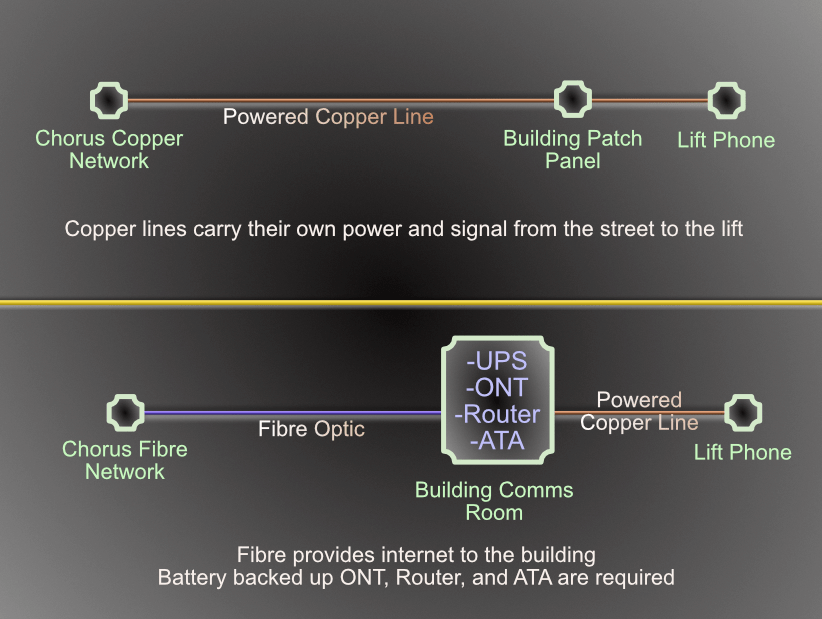
    For decades, analogue copper phone lines have quietly served as the backbone of emergency communication in lifts — bringing not just connectivity, but power directly from the street into the lift car’s emergency auto dialler telephone. This meant no on-site batteries, no modems, and reliable operation even in a power outage. But as Chorus phases out the copper network across New Zealand, buildings are required to shift to 4G cellular or fibre-connected systems. Unlike copper, fibre doesn’t carry power — so lift emergency phones must rely on on-site internet equipment and monitored battery backups to stay online. Where this phone line is provided through the building’s fibre connection this will include conversion equipment such as ATA (Analogue Telephone Adapters) so that the installed analogue lift phones can continue to work.

    Very often buildings are found to not have a UPS (uninterrupted power supply) for battery backup of important equipment. Furthermore battery backups require monitoring for the battery condition, and often have a maintenance requirement to replace the battery in as little as 2 years leaving another area of compliance and safety overlooked. The lift contractor may not have control or visibility of this equipment located elsewhere in the building, leaving a risk that maintenance and testing is neglected.

    This is a fundamental change that introduces new complexity and risk, and building owners need to plan carefully to ensure compliance, reliability, and safety are maintained. On a positive note, 4G and VOIP based solutions are significantly cheaper than the existing copper lines, which cost upwards of $70 a month.

    Louis Deverell of LDEV Tech has a decade of experience in implementing reliable connectivity solutions that do not rely on analogue telephone lines, and can function when critically needed in a power outage. Through a supporting division LDEV Connect, we can supply the industry with end to end products and solutions that include advice, hardware, with supporting SIM card and VOIP connectivity services. LDEV Connect supplies products from 2N, a leading global manufacturer of connectivity equipment. 2N products support cloud monitored connectivity to ensure the equipment is online and maintenance is up to date.
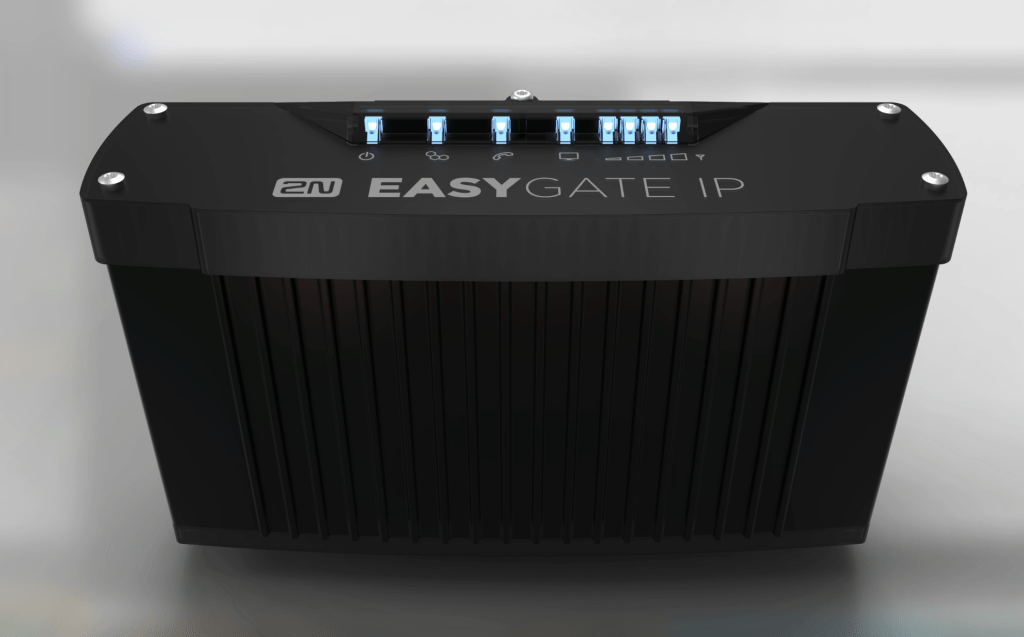
    Solutions such as the 2N EasyGate IP capture the full requirements of a 4G Dual-SIM gateway that can provide the analogue telephone line to the lift car, and carry high quality phone calls over VoLTE or VOIP. This single device is capable of cloud connected monitoring and configuration, and importantly features a built-in battery. The device needs no connection to the building external to the lift installation, and simply requires a power supply.
    Reference Chorus.co.nz – Withdrawing Copper Services

    Link: LDEV Connect

  • New Zealand 3G shutdown to affect lift emergency phones in 2025

    New Zealand 3G shutdown to affect lift emergency phones in 2025

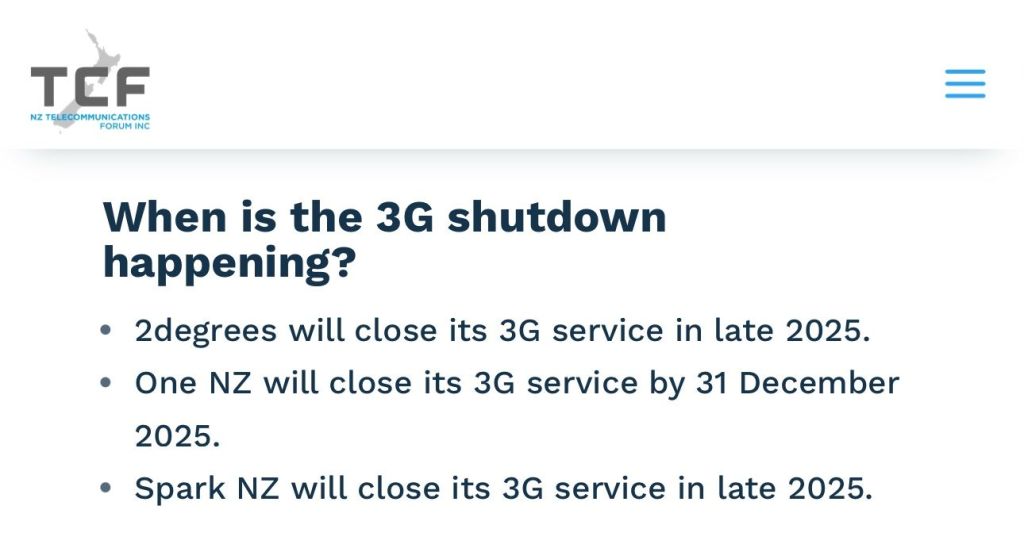
    Lift emergency phone gateways limited to 3G cellular calling in NZ will very soon need an upgrade to 4G, with VoLTE or VOIP capability.

    LDEV Connect can provide universally compatible solutions in New Zealand from the 2N range of lift communication products to help with this change. These solutions can be provided via your current lift company or building data and security contractors.

    You can contact your lift service provider to ask what phone number the lift is calling from. If they are not aware of providing this service to you, and if this is a cellular number in New Zealand such as beginning with 02x, +642x, or +2x (021, +6421, +21, 027, 022, 029 etc.) then it is likely to be using a cellular gateway. It is possible to contact the lift provider by testing the emergency phone and speaking to the operator.

    Your lift service provider will be your best first point of contact to advise you on the details they have about your emergency phone equipment.

    If the cellular gateway was not provided or maintained by the lift company, you will need to find out where in the building it is located, and have the device assessed for 4G VoLTE capability.

    Most often a lift is fitted with an analogue autodialler within the lift car. This will usually be a hands-free loudspeaker telephone which is activated by a long press of around 5 seconds of the alarm or phone buttons.

    The analogue autodialler will be connected to either a ‘landline’ from Chorus, or a ATA (analogue telephone adapter) device within the building.

    This ATA could be:

    • a cellular gateway installed within the lift shaft or machine area, or installed within a building comms room
    • connected to the building’s PBX internal phone network
    • a device connected to the Chorus fibre connection

    In all cases ATA equipment must have a battery backup which can last for at least 2 hours, and be regularly tested and maintained.

    Yes, when the correct system has been installed and maintained – batteries will allow the system to operate for at least 2 hours.

    Press and hold the alarm or phone button according to the signage within the lift car.

    If you do not hear a siren, or the phone does not activate – it may be due to an alarm nuisance filter which prevents a call from a lift that has the doors open and is in working order. To override this filter, you can hold the alarm button for 30 seconds until you hear the alarm sounding.

    In some cases, the device with ‘4G’ capability was for data communication only, and without the possibility to make phone calls. To make phone calls with 4G, this requires VoLTE (Voice over LTE). LTE is basically the 4G technology. If the device cannot be updated for VoLTE compatibility by a software change, then it must be replaced.

    The device may work until the 3G network is gradually phased out.

    Yes, however this will often require a change in the equipment installed to support VOIP (Voice over Internet Protocol). The internet connection and all associated equipment such as routers, fibre ONT, and switches must have a battery backup, or other fail safe backup. LDEV Connect can provide VOIP lift phone equipment in New Zealand, including monitored and battery backed up internet gateways with 4G dual sim capability – in case your wired internet connection is lost.

    The 2N LiftIP 2.0 and 2N LiftGate 4G are ideal solutions for VOIP lift phones.

    Yes, the 2N EasyGate 4G devices support VoLTE and VOIP, and convert this into an analogue telephone line for the lift autodialler. The device includes built-in battery backup and remote monitoring features.